Showing posts with label bread. Show all posts

Sunday, April 13, 2008

English muffins with egg and vinegar


These are really good English muffins. Here is the recipe. It came from Ruth Reichi, with cooking technique from Alton Brown:

Mix
1/3 cup warm water
1 Tbs sugar
1 package active dry yeast
in the bowl of the mixer.

Warm 1 2/3 cup milk and
3 Tbs butter till melted
Cool, then add 1 egg
and 1 Tbs vinegar
and add it all to the yeast.

Stir in 2 1/2 cups (340 grams) of flour and mix for 5 minutes.
Add another 2 1/2 cups (340 grams more) flour and mix with the hook for 5 more minutes.
Let rise for 1 hour. The dough tripled in one hour. After the rise, I put it in the refrigerator for another hour to make it easier to handle.

Preheat the griddle to 300 deg F. [I put water on mine as it heats so I can tell when the corners are hot.]
Scale the dough into about sixteen 80 gram pieces. Coat liberally with corn meal. I used my wooden dough bowl with corn meal in it to coat the dough. Works nice.

Place rings on the hot griddle and spray lightly with cooking spray. Place a piece of dough in each ring, then place a cookie sheet or jelly roll pan on top of the rings. This forces the dough to stay in the ring. Cook for 5 minutes, then slip the rings off and turn the muffins to cook the other side for 5 more minutes. You don't need the cookie sheet for the second side. They should be golden brown on both sides. Cool completely on a cooling rack. Split with a fork.


Wife and I split one, coated it with olive oil, kosher salt, Italian spices and Parmesan cheese, then broiled it for an appetizer. Good.

These were too thick and were scaled to 125 grams. I note in the recipe to use 80 grams. They will be thinner and more like commercial muffins.

The last time I made these, I made them in the evening, let the dough rise, then put it in the refrigerator overnight. I baked them in the morning for my son and his family. Worked like a charm. Do let them cool, though. That is the finish of the cooking.

Tuesday, November 20, 2007

Sourdough Potato Bread

Recently my wife and I and my sister ate dinner at a nice restaurant in Chattanooga, St. Johns, I think. They served a very nice sourdough potato bread. I decided to try to make some. My sourdough starter is sitting on the counter ready to use.

I used Google to find recipes on the internet and found several that were all the same. The one I choose was www.basic-recipes.com/bds/potato.htm. It calls for instant mashed potato, so I used my favorite instant potato, Hungry Jack. These are flakes of russet potato. I followed the recipe and at the end, no bake temperature or time was given. So...I turned on the convection oven to 450, put a cup of water into the cast iron frying pan on the bottom, and put the bread in to bake, essentially a cold oven start. I set the timer for 30 minutes. Then turned on the oven light. The bulb was burned out! I used a flashlight to monitor the bake process. After 15 minutes, the bread was browning a little quickly, so I turned the oven down to 350 and continued. At the end of the 30 minutes this is what we got. The bread internal temp was 200 degrees F.


Here is the crumb. The bread has a barely sweet flavor and a soft crumb but still sturdy enough to not break when spreading the butter. I served it warm. We will have more tomorrow on Thanksgiving when everybody is here.

Wednesday, November 15, 2006

NYT no knead bread in a dutch oven

This is my report on testing the NYT no-knead bread recipe as described on the alt.bread.recipe newsgroup. I took pictures as I went along, so you can see how I did.

To begin, here is the recipe that I used:

3 cups all-purpose flour, more for dusting [I used Hodgsens Mill AP, 390 grams]
1 5/8 cup water
1/4 tsp instant yeast
1 1/4 tsp salt [ I used 1 3/4 tsp kosher salt]
Cornmeal or wheat bran as needed [not used]

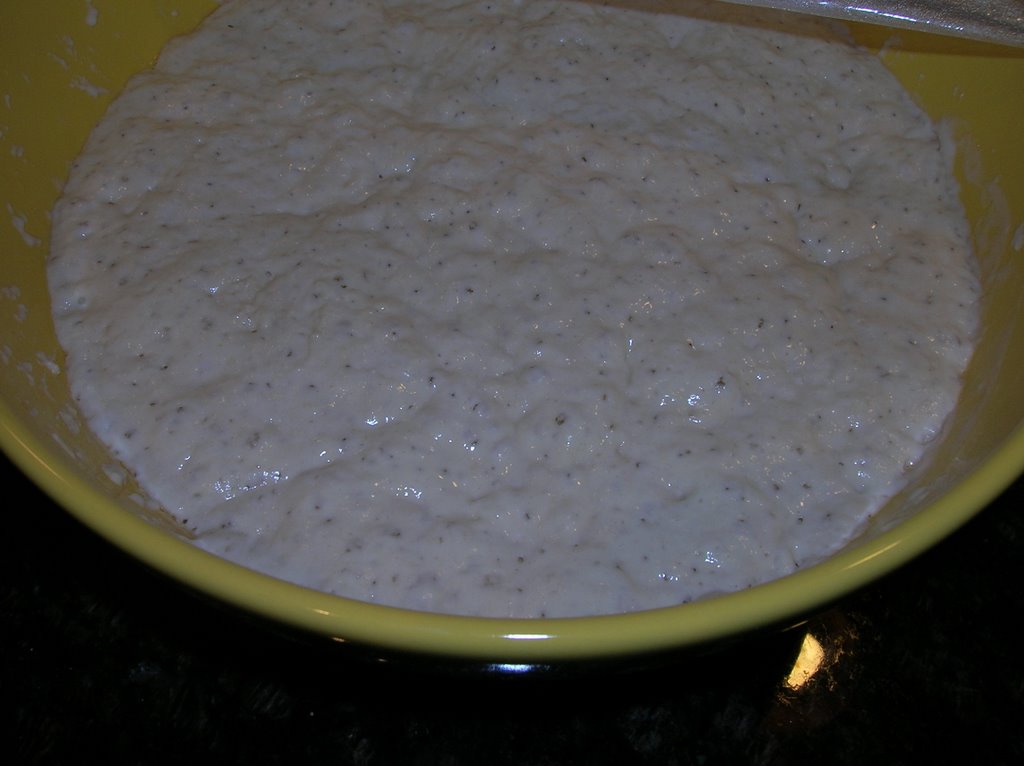
Combine ingredients and let rise for 12 to 18 hours at room temperature. Here is what it looks like after fermentation.

Place dough on a lightly floured work surface and sprinkle with flour, then fold it over on itself once or twice. The dough is very wet, over 90 % hydration, but is manageable. Cover the dough and let it rest for 15 minutes.

Clean the cast iron dutch oven. Warm the iron if cold. Lightly oil the interior.

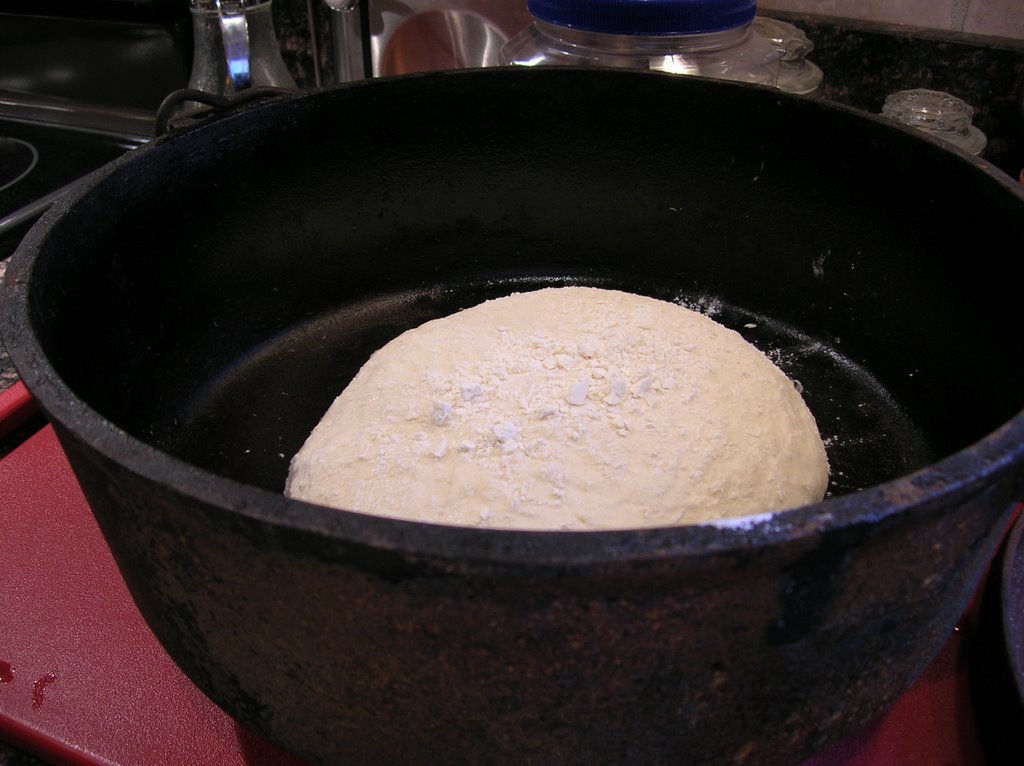
Shape the dough into a ball and place it into the dutch oven. I used two taping knives, the kind used for installing wallboard, to lift the very soft dough and place it into the cold dutch oven.
Two taping knives used to lift the soft dough.

The dough in the dutch oven ready to rise for 2 hours.


Here it is, ready to go into the oven.


Let it rise for about 2 hours. Cut the dough in four places with a razor.

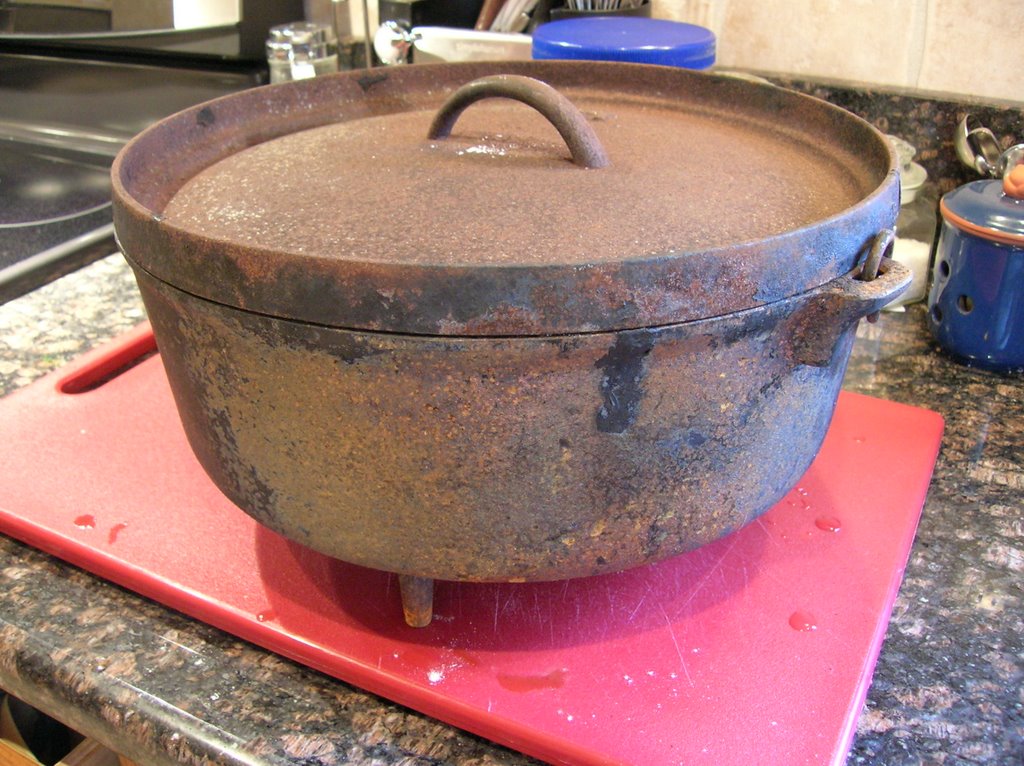
Cover the oven with the lid, then place the dutch oven into a cold oven. Turn the oven on and set the temperature for 450 deg F.

After 30 minutes, remove the cover from the dutch oven. [I used a plant hanger from the garden to do this. Normally I use a metal tent stake, but none were at hand.] I put the cover on the ceramic tile kitchen floor. Don't put it on a plastic or wood surface.

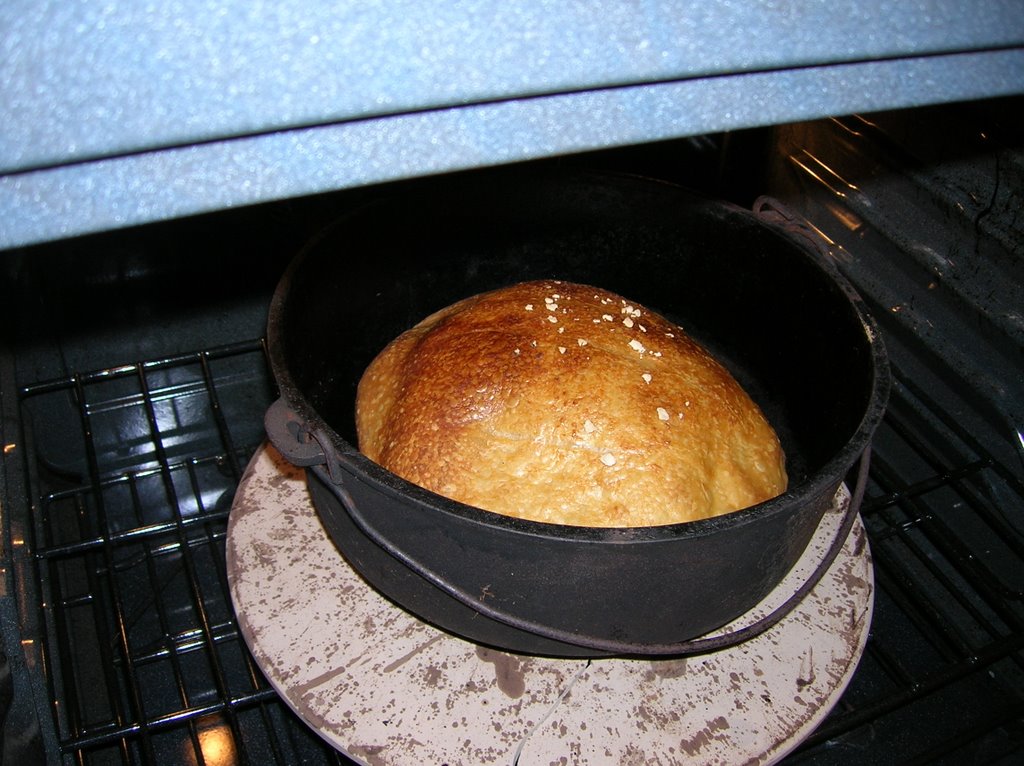
At this point the dough had risen and the crust was beginning to brown. It did not crack or open where I had made the cuts. They had resealed themselves.


Bake the loaf for another 30 minutes till done. [I over baked it and the crust was too hard.]

Turn the oven off and open the door for 5 minutes. Then remove the dutch oven and remove the bread to cool on a rack for 20 minutes.


This is the loaf as it cools. It spread out but not enough to cover the bottom of the 12 inch dutch oven. It is nicely browned. It did not stick to the bottom of the oven and came up easily. The oven was lightly greased before the loaf was placed in it.

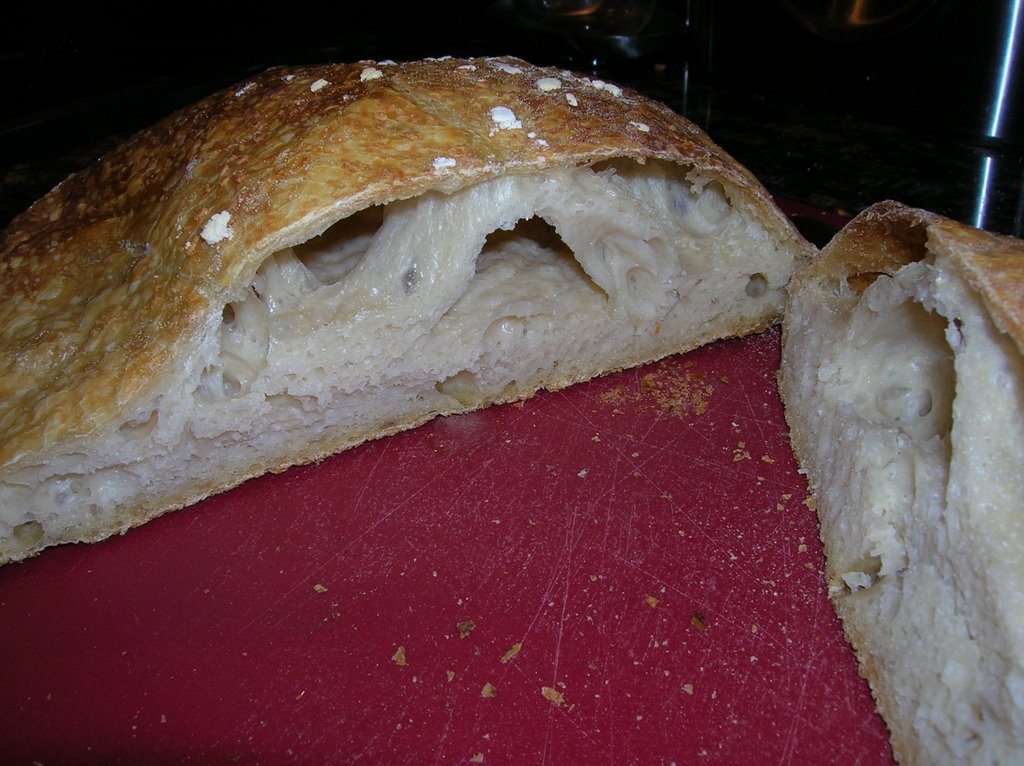
Cut open to show the crumb shows huge holes. The crust was very tough and hard to cut with a bread knife. The texture of the bread was coarse and tough. All in all not a very good loaf of bread.

Next - more baguettes.